If you’ve ever filled out a personal loan application only to get a vague rejection message — or an approval for far less than you asked for — you already know that “eligibility” is not a single number. It’s a combination of factors, and most applicants only find out which ones worked against them after the fact.
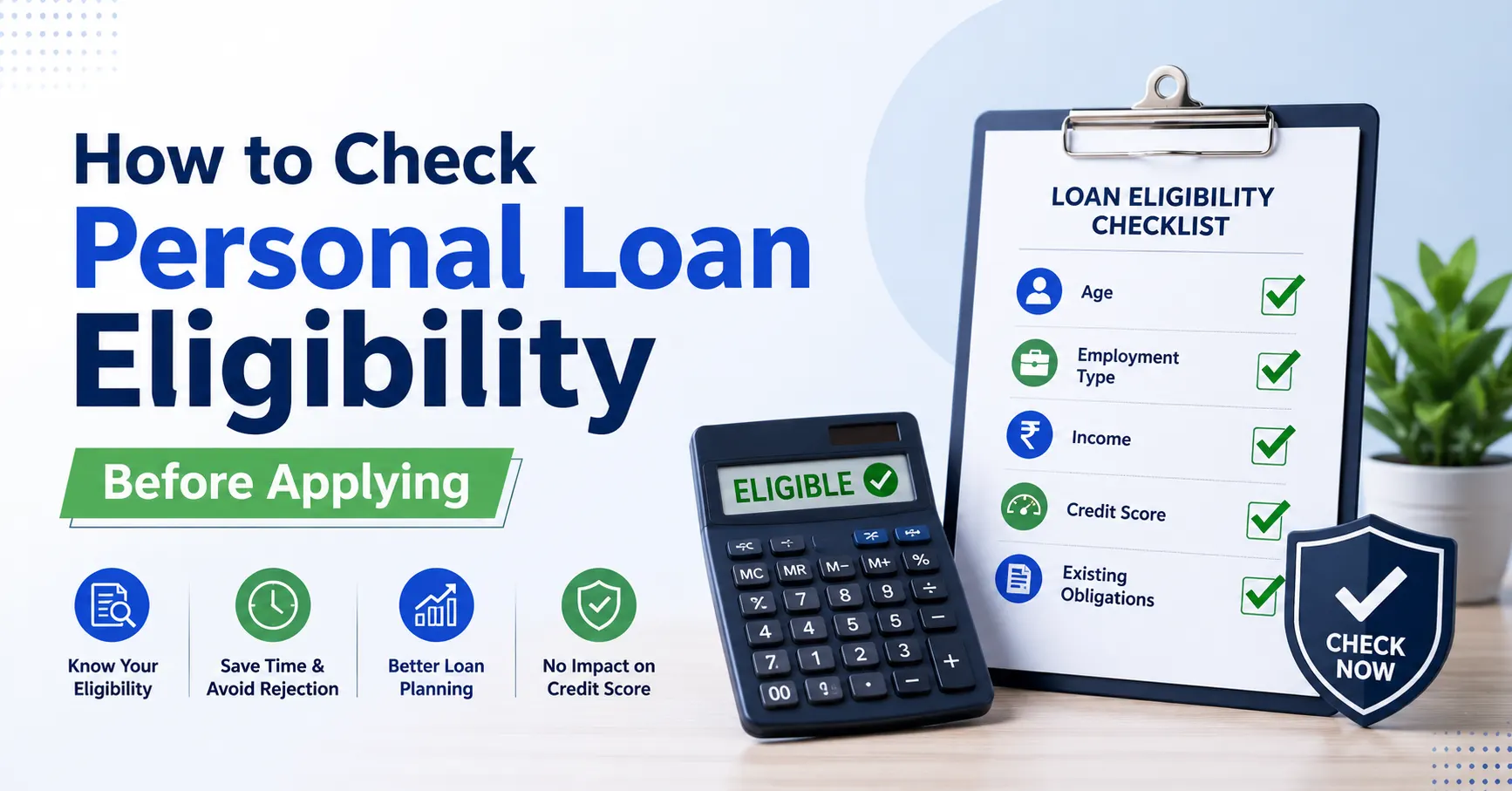
In short: personal loan eligibility in India typically depends on your credit score (most lenders prefer 700–750+), your monthly income, how much of that income is already committed to existing EMIs, your job stability, and your age. Banks tend to be stricter on all of these; NBFCs and fintech lenders are often more flexible but charge more for the risk.
The rest of this guide breaks down what each of these factors actually means in practice, so you can check your own position before a lender does it for you.

Why a Good Credit Score Alone Doesn’t Guarantee Loan Approval
A lot of applicants assume eligibility is mostly about credit score. It’s a major factor, but not the only one — and it’s possible to have a strong score and still get rejected, or a mediocre score and still get approved.
That’s because lenders are really asking one question: if we lend you this money, how confident are we that you’ll repay it without strain? Your credit score answers part of that. Your income and existing debt answer another part. Your job type and how long you’ve held it answer a third. A weak answer to any one of these can outweigh strong answers to the others.
Here’s a quick snapshot of how these factors typically interact, before we go through each one in detail:
| Eligibility Factor | What Lenders Are Really Checking | Why It Matters |
|---|---|---|
| Credit score | Repayment history and credit behaviour | Signals how reliably you’ve handled borrowed money in the past |
| Monthly income | Your capacity to take on a new EMI | Determines the loan amount you can realistically be offered |
| Existing EMIs (FOIR) | How much income is already committed | A high existing burden can sink an application even with a good score |
| Employment type and stability | Consistency of income over time | Job-hopping or irregular income raises repayment-risk concerns |
| Age | Whether the loan tenure fits your working years | Affects both eligibility and the maximum tenure offered |
No single row above decides the outcome on its own — lenders weigh them together, and a weak point in one area can often be offset by strength in another.
CIBIL Score for a Personal Loan: What Different Ranges Typically Mean
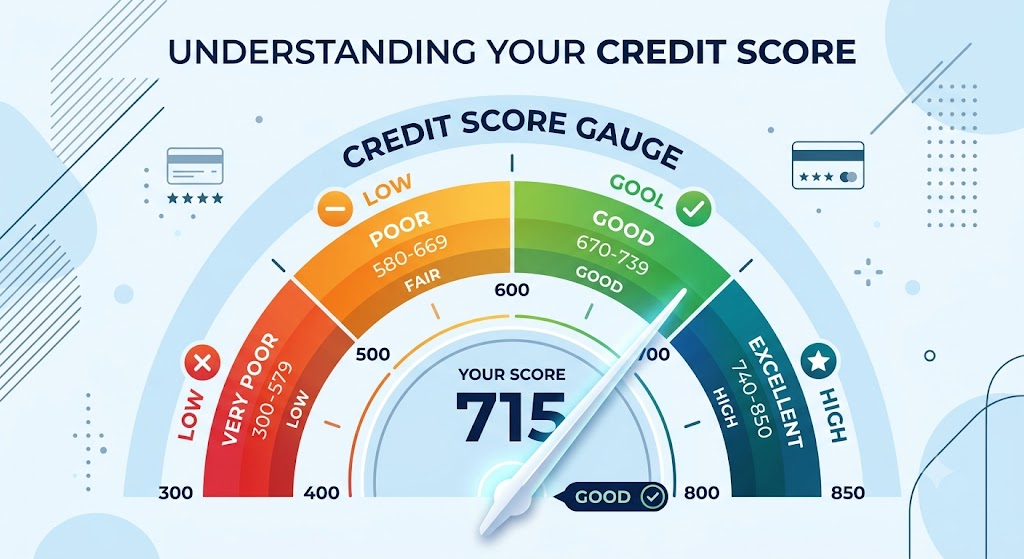
Your CIBIL score is a three-digit number between 300 and 900, generated from your credit history — how you’ve repaid loans and credit cards in the past, how much of your available credit you use, and how long you’ve had credit accounts open. TransUnion CIBIL is the most widely used bureau in India, though Experian and a couple of others also operate here.
As a general pattern across most lenders:
| CIBIL Score Range | What It Usually Means |
|---|---|
| 750 and above | Considered strong by most banks; better chance of approval and more competitive interest rates |
| 700–749 | Generally acceptable to many lenders, though terms may be slightly less favourable |
| 650–699 | Some NBFCs and fintech lenders may still consider you, often at higher rates |
| Below 650 | Approval becomes harder with traditional banks; secured loans or a co-applicant may help |
These ranges are broad tendencies, not fixed rules. Every lender sets its own internal cutoffs, and some — particularly newer digital lenders — factor in things like bank statement patterns, UPI transaction history, or repayment behaviour on smaller loans, especially for applicants who don’t have an established CIBIL history. If your score falls short of what a particular bank prefers, that doesn’t automatically rule you out elsewhere; it usually just narrows down which lenders are realistic options.
One thing worth knowing: checking your own credit score is a “soft inquiry” and doesn’t affect your score at all. What can lower it, even slightly, is applying to several lenders in a short window — each application triggers a “hard inquiry,” and too many of these close together can make you look credit-hungry to the next lender who checks.
Income and FOIR: The Ratio That Often Matters More Than Salary Alone
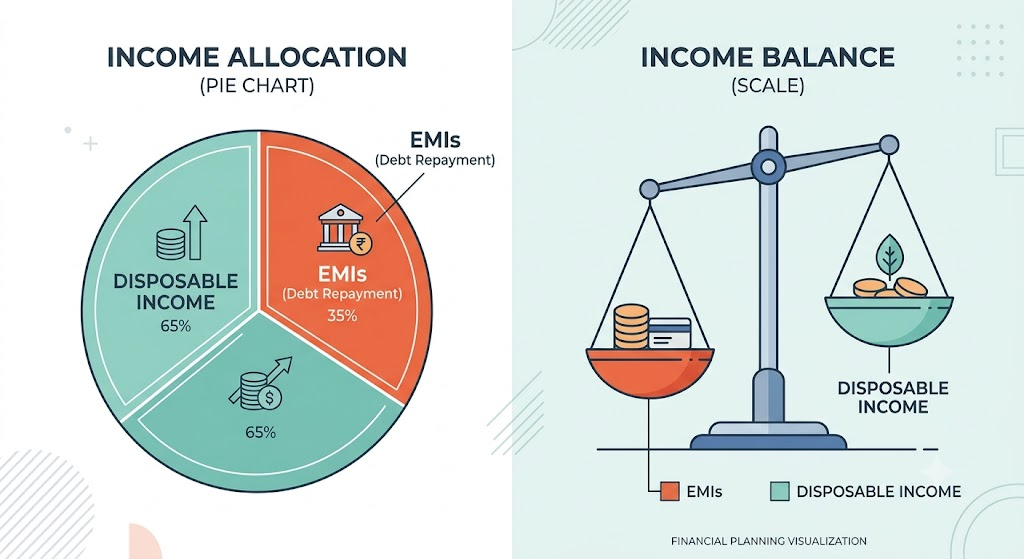
Most people know lenders check income, but fewer know about the ratio that often decides the outcome: how much of your monthly take-home pay is already going toward existing EMIs. This is sometimes called the Fixed Obligation to Income Ratio (FOIR), or debt-to-income ratio.
Here’s a simple way to think about it. Suppose your monthly take-home salary is ₹60,000, and you’re already paying ₹20,000 toward a car loan EMI. That’s roughly one-third of your income already committed. If you then apply for a personal loan that would push your total EMI obligations past what the lender considers a safe threshold — often somewhere in the 40–50% range, though this varies by lender and by how they weigh other factors — your application is more likely to be scaled down or declined, even if your credit score looks fine.
This is also why two applicants earning the same salary can get very different outcomes. Someone with no existing loans has more room; someone already carrying a home loan or a couple of active EMIs has less, regardless of how healthy their income looks in isolation.
Minimum income requirements themselves vary widely — by lender, by city (metro cities often have somewhat higher thresholds than smaller towns), and by whether you’re salaried or self-employed. Rather than relying on a fixed number, it’s more useful to check the specific lender’s stated minimum income for the loan amount you’re considering, since this is one of the details that changes most often.
Salaried vs. Self-Employed: How Job Stability Is Assessed Differently
Lenders generally divide applicants into salaried and self-employed categories, and each is assessed a little differently.
For salaried applicants, continuity in your current job matters — most lenders want to see a reasonable stretch of stable employment, and frequent job changes in a short period can raise questions even if your salary itself is adequate. The nature of your employer also plays a role in practice: some banks are known to offer smoother approvals or marginally better rates to employees of well-established, larger companies, while applicants from smaller or newer organisations may face additional scrutiny. This isn’t usually a published rule, so it’s worth asking a loan officer directly if you’re unsure where your employer falls. If you’ve recently switched jobs or are still on probation, it’s also worth checking with the lender directly — some prefer to see at least a few months of salary credits in the new role before considering an application, since a probation period can read as less stable even when the job itself is secure.
For self-employed applicants — business owners, freelancers, professionals — lenders typically look at income tax returns and business continuity over a period of a few years rather than a single payslip, since income can fluctuate. If you’re self-employed, it’s worth having at least a couple of years of consistent ITRs ready, along with business proof, before you apply.
Age Eligibility: Minimum and Maximum Limits for a Personal Loan
Most lenders set a minimum age (commonly around 21) and a maximum age by which the loan must be fully repaid (often somewhere between 58 and 65, sometimes higher for certain categories like government employees or pensioners). The logic is straightforward: lenders want the loan tenure to fall within your expected working or income-earning years. If you’re closer to the upper end of a lender’s age bracket, you may be offered a shorter tenure rather than being declined outright.
check our guide for more info on this: Common Reasons Why Personal Loan Applications Get Rejected
What to Do If You Don’t Meet a Lender’s Eligibility Criteria
A rejection or a lower-than-expected offer from one lender doesn’t necessarily mean you’re ineligible everywhere. A few approaches that applicants commonly use:
- Applying with a co-applicant. If a family member with a stronger income or credit profile co-signs, the combined profile can look less risky to a lender.
- Considering a secured personal loan, where you pledge an asset such as a fixed deposit. This can reduce a lender’s reliance on your credit score alone, though it does put the pledged asset at risk if repayment falls behind.
- Requesting a smaller loan amount. A lower ask is inherently a lower risk for the lender, and can sometimes tip a borderline application toward approval.
- Approaching an NBFC or fintech lender, several of which use a wider set of data points beyond just your CIBIL score. This flexibility often comes at the cost of a higher interest rate, so it’s worth weighing the trade-off carefully rather than defaulting to the fastest approval.
Suppose your CIBIL score sits at 680 and a couple of banks have already turned you down. Rather than repeatedly applying to more banks — which only adds hard inquiries and can push your score down further — it’s usually more productive to pause, check what specifically is holding your application back (score, income, or existing EMI load), and address that before applying again.
Documents Required for a Personal Loan — and Why Each One Is Asked For
Document requirements differ by lender, but each document generally serves a specific purpose in how the lender evaluates your application — it isn’t just paperwork for its own sake.
| Document | Why the Lender Asks For It |
|---|---|
| Identity proof (PAN card, Aadhaar) | Confirms who you are and links your application to your credit history and tax records |
| Address proof | Verifies where you live, which affects communication, legal recourse, and sometimes the lender’s own regional eligibility rules |
| Income proof (salary slips, bank statements for salaried applicants; ITRs and business proof for self-employed applicants) | Establishes your actual repayment capacity, beyond what a credit score alone shows |
| Bank statements (typically the last 3–6 months) | Lets the lender see real cash flow, existing EMI debits, and spending patterns — not just the income figure you declare |
| Passport-size photographs | A standard KYC requirement across nearly all regulated lenders |
| Duly filled and signed application form | The formal record of your consent and the details you’re submitting for evaluation |
Self-employed applicants are often asked for a few additional items — such as business registration proof or audited financials — since there’s no single payslip to establish income the way there is for a salaried applicant.
Some lenders may ask for additional documents depending on the loan amount or your specific profile, so it’s worth checking the exact list on the lender’s official page before you start gathering paperwork.
How to Check Your Personal Loan Eligibility Before You Apply
Before applying, it can help to run through this sequence:
- Check your CIBIL score (most banks and several apps now offer this for free).
- Add up your existing EMIs and compare them against your monthly take-home income.
- Confirm your age falls within the lender’s stated range for the loan tenure you want.
- Have your income documents ready and roughly matching what the lender typically asks for at your income level.
If two or three of these look weak, it may be worth strengthening your position — paying down a smaller loan, waiting a few months for a stable salary history, or checking your credit report for errors — before applying, rather than applying anyway and absorbing a hard inquiry for an uncertain outcome.
The Bottom Line Before You Apply
Personal loan eligibility isn’t a pass-or-fail test decided by one number — it’s a combined picture of your credit score, income, existing debt, job stability, and age, and different lenders weigh these differently. That’s precisely why the same applicant can be rejected by one bank and approved by another within the same week.

The most useful thing you can do before applying isn’t to guess which lender is “easiest” — it’s to check your own position honestly first: pull your credit score, work out your real FOIR, and confirm your documents match what your income level typically requires. If your profile looks strong across most of these, you’re in a good position to compare interest rates and choose the best offer. If one or two areas look weak, it’s usually worth addressing them first — even a few months of stronger repayment history or a lower EMI load can shift you from a borderline case to a straightforward approval, and save you from unnecessary hard inquiries in the process.
Because eligibility criteria and interest rates do change from lender to lender and over time, treat this guide as a framework for what to check — not a substitute for confirming the current terms directly with the lender you’re considering.
Check this guide for more understanding: How to Improve Your CIBIL Score for Loan Approval
Frequently Asked Questions
Is there one minimum CIBIL score that applies everywhere?
No. Different lenders set different internal thresholds, and some also weigh alternative data for applicants without an established credit history. A score of 750+ is broadly considered strong, but it isn’t a universal cutoff.
Can I get a personal loan with no credit history at all?
It’s possible with some lenders, particularly NBFCs and fintech platforms that assess income and banking behaviour rather than relying solely on a CIBIL score, but terms are usually less favourable than for applicants with an established credit history.
Does checking my own eligibility or credit score hurt my score?
No. Checking your own score is a soft inquiry and has no effect on it. It’s only when a lender checks your report after you’ve submitted an application that it counts as a hard inquiry.
Will applying to multiple lenders at once improve my chances?
It’s more likely to work against you. Multiple applications in a short window generate multiple hard inquiries, which can lower your score and make you look less attractive to the very lenders you’re applying to.
Does the loan amount I request affect my eligibility?
Yes, indirectly. A smaller loan amount usually means a smaller EMI, which is easier to fit within a lender’s FOIR threshold. Requesting the maximum amount you think you might qualify for isn’t always the safest approach — a more conservative request against your income can improve your approval odds.
Financial Disclaimer: Loan eligibility criteria, minimum credit scores, income requirements, interest rates, and approval processes vary significantly between banks, NBFCs, and fintech lenders, and can change over time. This article is for general informational purposes only and is not financial advice. Readers should verify current eligibility criteria and terms directly with the relevant lender before making any borrowing decision.