Quick Answer
- KYC helps banks verify your identity, address, and, where necessary, the legitimacy of financial activity linked to your account.
- It’s a regulatory requirement under RBI’s KYC guidelines, not a bank-specific preference.
- Banks re-verify KYC periodically, more often for higher-risk or high-value accounts.
- Incomplete or mismatched KYC details can delay loan disbursal and restrict account access.
- e-KYC and video KYC let much of this happen online, though not every account type qualifies.
- Keeping your documents current is the simplest way to avoid banking and loan delays.
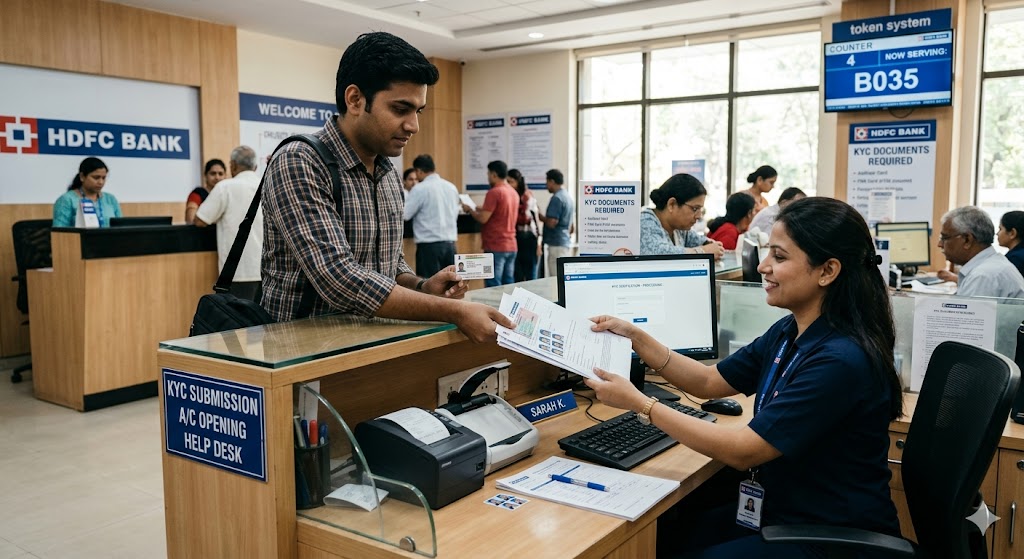
Banks ask for KYC (Know Your Customer) documents to confirm who you are, where you live, and whether the money moving through your account can be reasonably explained. This isn’t paperwork for its own sake — it’s how banks meet RBI-mandated identity verification rules and reduce the risk of fraud, identity theft, and misuse of the financial system. For the customer, it means a slightly longer onboarding process in exchange for an account that’s harder for someone else to hijack.
That short answer covers the basics, but it doesn’t explain why the process feels repetitive, why some banks ask for more than others, or why KYC keeps resurfacing years after you first opened an account. That’s where most of the confusion actually lives.
The Real Reason KYC Exists
Picture a bank that let anyone open an account with just a name and a phone number. Within weeks, that account could be used to route money from a scam, launder cash from an unrelated crime, or impersonate someone who never applied for anything. The bank wouldn’t necessarily know — and by the time anyone noticed, the trail would already be cold.
KYC exists to close that gap before it opens. Banks in India follow verification standards set out in the Reserve Bank of India’s Master Direction – Know Your Customer (KYC), which itself sits within a broader global effort against money laundering and terror financing. So when a bank asks for your Aadhaar, PAN, or a recent utility bill, it isn’t being cautious for the sake of appearances — it’s fulfilling a regulatory obligation that applies to every account, every lender, and every NBFC operating in the country.
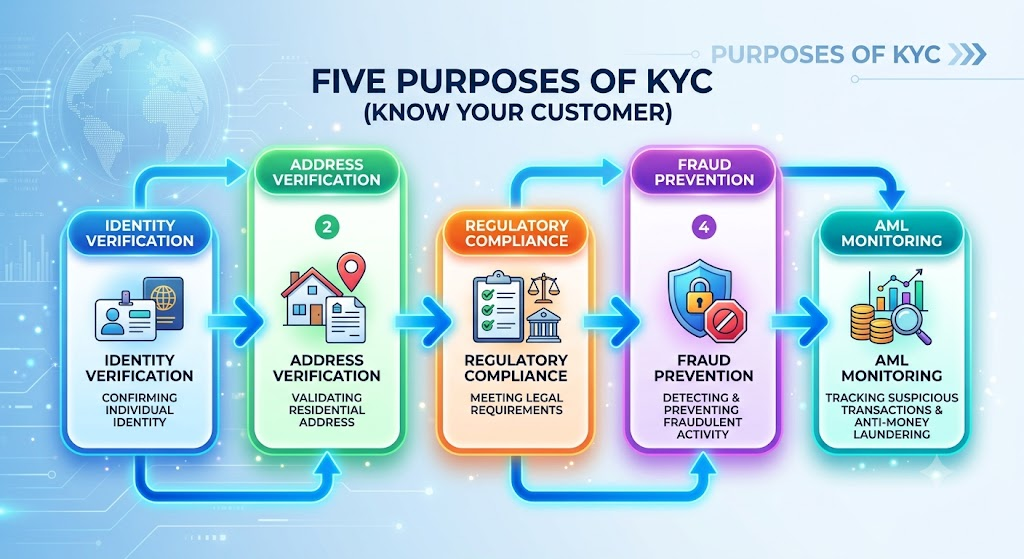
The documents themselves serve more than one purpose, and it helps to see them broken down rather than treated as one generic pile of “proof”:
| Purpose | What It Verifies | Why It Matters |
|---|---|---|
| Identity Verification | That you are who you claim to be (Aadhaar, PAN, passport, voter ID) | Prevents someone else from opening an account or taking a loan in your name |
| Address Verification | Where you actually live (utility bills, rental agreements, bank statements) | Ensures the bank can reach you and confirms you’re not using a false location |
| Compliance | That the account follows the KYC process required of banks under RBI’s guidelines | Protects the bank’s licence to operate and your legal standing as an account holder |
| Fraud Prevention | That the details submitted are genuine and internally consistent | Reduces the chances of impersonation, forged documents, or duplicate accounts |
| AML Monitoring | Ongoing tracking of unusual transaction patterns | Flags money laundering or terror financing before large sums move undetected |
Most people only think about identity and address. The other three are quieter, but they matter just as much — especially for loan applications and high-value transactions.
Why the Same Bank Might Ask You Twice
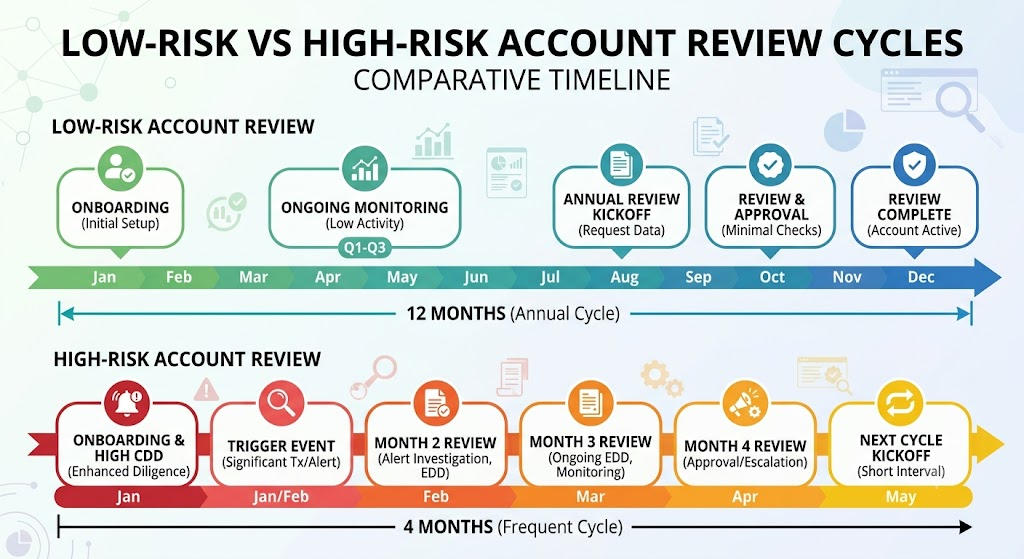
If you’ve ever wondered why a bank you’ve used for years suddenly asks you to resubmit KYC documents, the answer usually isn’t suspicion about you specifically — it’s a periodic review cycle. RBI’s KYC guidelines require banks to re-verify customer information at set intervals, and how often that happens can depend on the risk category your account falls into.
A salaried customer with a stable, low-value savings account is typically reviewed less frequently than someone with large or irregular transactions, multiple accounts, or a business relationship with the bank. This is sometimes called risk-based KYC, and it explains why two people at the same bank can have very different re-verification timelines. If you’re unsure which category applies to you, the most reliable answer will come directly from your bank’s KYC or compliance desk rather than a generic rule of thumb — practices do vary by institution.
What Happens If You Ignore a KYC Request
This is the part that catches people off guard. Banks don’t send repeated reminders indefinitely. If KYC documents aren’t updated within the window a bank specifies, accounts are often restricted rather than closed outright — meaning you may still be able to receive funds, but withdrawals, transfers, or certain transactions get frozen until the update is completed.
Suppose you’ve moved cities and never updated your address, and your bank sends a KYC renewal notice to your old address. If you miss it, you might only discover the restriction when a transaction fails. This is a common, avoidable situation — not a sign that something is wrong with the account, just a paperwork gap that compounds over time.
For loan applicants specifically, incomplete KYC can delay disbursal even after approval, since lenders are required to complete verification before releasing funds. It’s worth checking KYC status proactively if you’re mid-application on a loan and have recently changed your address, phone number, or the documents required for bank KYC.
Does KYC Affect Your Loan Eligibility?
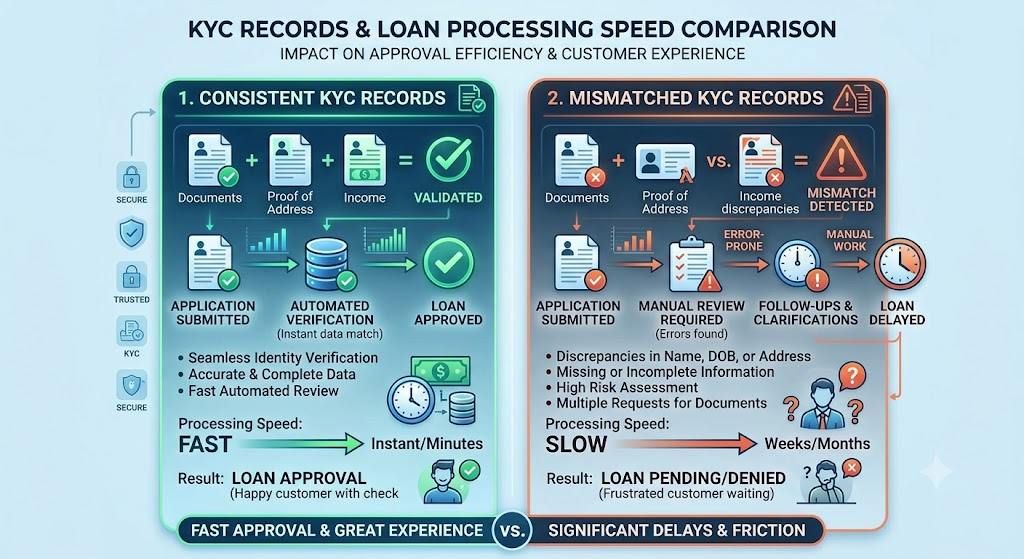
Not directly — but it interacts with eligibility in a way that’s easy to underestimate. Bank KYC verification alone doesn’t determine whether you qualify for a loan; that depends on income, credit score, and repayment capacity. However, incomplete or mismatched KYC details can stall an otherwise-approved application, and inconsistent information across documents (a name spelled differently, an outdated address, a PAN that doesn’t match your Aadhaar) is one of the more common, avoidable causes of processing delays.
Consider two borrowers with identical credit profiles applying for a personal loan. One has consistent KYC records across PAN, Aadhaar, and bank statements. The other has an old address on file and a name mismatch between PAN and Aadhaar. Both may eventually get approved, but the second borrower is far more likely to face a request for clarification, which pushes disbursal back by days or weeks. Keeping KYC details current isn’t just a compliance formality — it’s a small thing that quietly prevents avoidable delays.
Digital KYC vs In-Person Verification
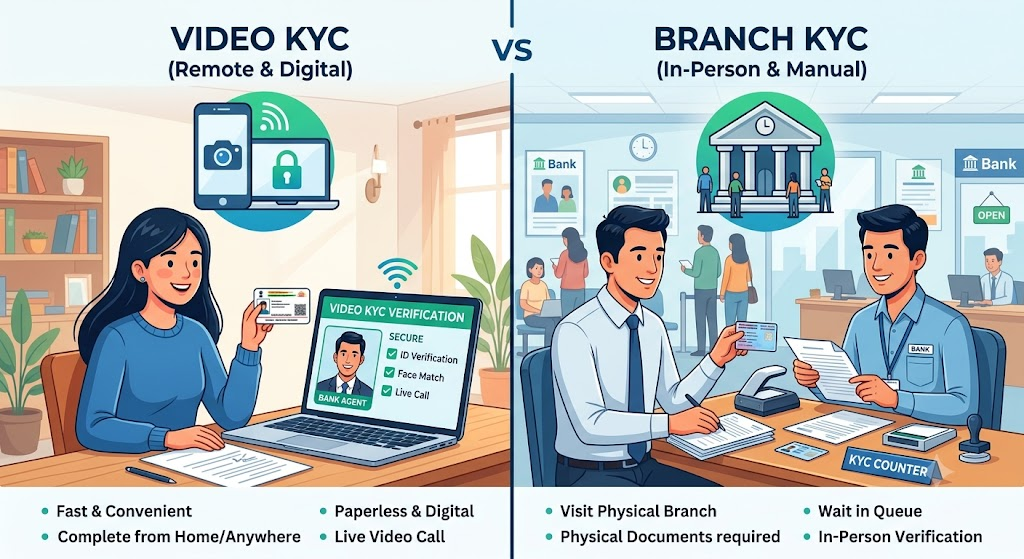
Many banks and NBFCs now offer video KYC or Aadhaar-based e-KYC, which can complete verification in minutes rather than requiring a branch visit. This is convenient, but it’s worth understanding what’s actually different: digital KYC still confirms the same underlying identity, address, and financial details — it simply does so through biometric or OTP-based authentication instead of physical document checks.
Not every account type qualifies for fully digital KYC, and some banks still require in-person verification for high-value accounts, certain loan products, or customers without a mobile number linked to Aadhaar. If you’re choosing between the two, it’s reasonable to ask your bank directly which option applies to your specific account type, since this varies by lender and by the product you’re applying for.
A Quick Word on Documents That Confuse People
PAN and Aadhaar are sometimes treated as interchangeable, but they serve different functions. Aadhaar primarily verifies identity and address; PAN is tied to your financial and tax history and is required for most loan and investment-related KYC. Having one without the other, or having them linked incorrectly, is a frequent source of the delays described above — and it’s worth confirming the linkage is correct rather than assuming it is.
Common Mistakes People Make During KYC
Most KYC delays aren’t caused by anything dramatic. They come from small inconsistencies that seem minor until a bank’s system flags them.
Name mismatch across documents. A middle name included on PAN but dropped on Aadhaar, or a surname spelled slightly differently across documents, can be enough to stall verification. Banks aren’t being pedantic here — their systems are designed to match records exactly, and a mismatch simply can’t be waved through manually in most cases.
Old address on file. If you’ve moved and never updated your KYC address, renewal notices and even loan-related communication can go to a place you no longer live. This is one of the more common reasons people discover a restricted account only after a transaction fails.
Expired documents. Passports and certain ID proofs have expiry dates, and submitting an expired document is treated the same as submitting no document at all. It’s worth checking expiry dates before an application rather than after a rejection.
PAN and Aadhaar mismatch or linking issues. As covered earlier, an unlinked or mismatched PAN-Aadhaar pair is one of the more disruptive KYC issues, since it can block loan and investment-related verification entirely until it’s corrected.
Incorrect mobile number. Since much of e-KYC relies on OTP-based Aadhaar authentication, a mobile number that’s no longer linked to your Aadhaar can block the entire digital verification process, forcing a branch visit that could otherwise have been avoided.
None of these mistakes are serious on their own, but each one can quietly delay account access or loan processing by days or weeks — often at the exact moment funds are needed most.
Frequently Asked Questions
Is Aadhaar mandatory for bank KYC?
Aadhaar is widely accepted and often the fastest route to e-KYC, but it isn’t the only valid identity document. Banks generally accept PAN, passport, or voter ID as alternatives, though acceptable combinations can vary by bank and account type.
Can KYC be completed entirely online?
In many cases, yes — through video KYC or Aadhaar-based e-KYC. However, some account types, loan products, or customers without an Aadhaar-linked mobile number may still need in-person verification at a branch.
How long does KYC verification usually take?
Digital KYC can often be completed within minutes to a few hours, while document-based or in-person verification may take longer depending on the bank’s internal process. Time frames aren’t standardised across institutions, so it’s worth checking directly if you’re on a deadline.
What documents are usually accepted for KYC?
Aadhaar, PAN, passport, voter ID, and driving licence are commonly accepted for identity, while utility bills, rental agreements, and bank statements are typically used for address proof. Exact requirements depend on the bank and the type of account or loan.
What happens if my KYC details don’t match across documents?
The bank will usually pause processing and request clarification or corrected documents rather than rejecting the application outright. This is inconvenient but fixable — updating the mismatched document, or linking PAN and Aadhaar correctly, generally resolves it.
In Summary
KYC can feel like an obstacle, but it exists to protect both sides of the relationship — the bank, which is legally required to know who it’s serving, and the customer, whose account becomes far harder to misuse or impersonate as a result. Most of the friction people experience with the KYC process in banks isn’t caused by the system itself, but by small, avoidable gaps: an old address, a name that doesn’t quite match, a mobile number no longer linked to Aadhaar. Keeping your documents current is a small habit that saves real time later, particularly if you ever need a loan disbursed quickly or a restriction on your account lifted without delay.
Financial Disclaimer
KYC requirements, re-verification timelines, and accepted document types can vary between banks, NBFCs, and account types, and RBI guidelines are periodically updated. The information here is for general understanding only — please verify current KYC requirements directly with your bank or NBFC before acting on time-sensitive matters like loan disbursal or account restrictions.