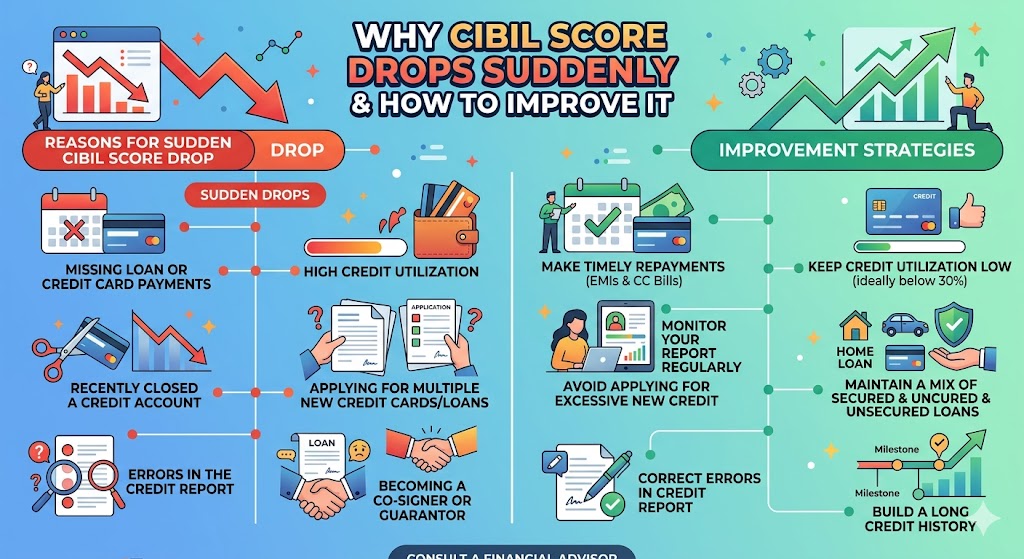
Opening your credit report and seeing a lower number than you expected is unsettling, especially if you haven’t missed a single payment or applied for anything new recently. The good news is that a sudden CIBIL score drop is rarely a sign of a serious financial crisis. In most cases, it’s the result of one identifiable event — a missed payment, a new loan inquiry, high card usage, or even a reporting delay from your bank. This article walks through the actual reasons scores fall, how much each one typically matters, and what to check first before you assume the worst.
Quick Answer
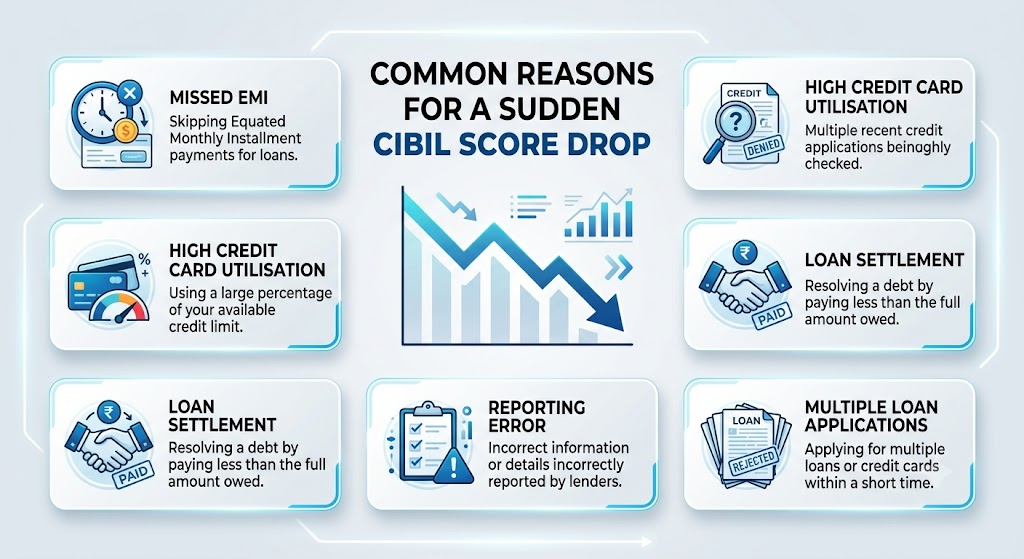
- Most common causes: a late or missed EMI, high credit card utilisation, a new hard inquiry, an old account closure, or a loan settlement instead of full closure.
- First thing to check: pull your full credit report (not just the score) and compare it to your last known report to spot what actually changed.
- Can it recover? In most cases, yes — a score that dropped due to a single identifiable event tends to improve gradually as you maintain consistent, on-time credit behaviour.
- When to dispute: if you find an account, payment status, or inquiry on your report that you don’t recognise or believe is inaccurate, raise it with the bureau and lender directly rather than waiting for it to correct itself.
Some of these causes lead to a small, temporary dip. Others can cause a sharper fall that takes longer to recover from. The right response depends entirely on which one applies to you, which is why checking your full credit report comes before anything else.
Not Every Drop Means You Did Something Wrong
Before going through the list, it’s worth separating two very different situations. Some score movements happen because of something you did — like missing a due date. Others happen because of how the credit ecosystem works in the background — reporting cycles, data updates from multiple lenders, or even a bureau recalculating your score using a slightly different model. Both are normal parts of having an active credit profile. A small dip can happen simply because your credit utilisation was higher on the exact date your bank reported data to the bureau, even if you paid the bill in full a week later.
Knowing which situation you’re in changes what you should actually do next. A behavioural cause usually has a clear fix. A structural or timing-related one often corrects itself on its own in the following cycle.
A quick real-life example: Priya, a salaried professional with a consistent repayment history, noticed her score had dropped after she checked it one morning. She hadn’t missed a payment or taken any new loan. On reviewing her report, she realised her credit card statement had generated while she was carrying a large balance from a flight booking — pushing her utilisation well above her usual range for that one cycle. Once she paid it down and the next reporting cycle passed, her profile reflected her normal usage again. Nothing was actually “wrong” with her credit behaviour; the score simply captured a temporary snapshot.
How CIBIL Scores Actually Get Updated
Your CIBIL score isn’t recalculated the moment something happens in your financial life. Banks and NBFCs report your account activity — payments, balances, new loans — to the bureau periodically, typically once a month, so there’s often a lag between something happening (say, you clearing a credit card bill) and your score reflecting it. If you check your score right after a big purchase or right before your statement date, you may be looking at a temporary snapshot rather than your “settled” financial position. If you’re newer to how these scores are built in the first place, our Credit Score Guide covers the basics before you dig into troubleshooting a drop.
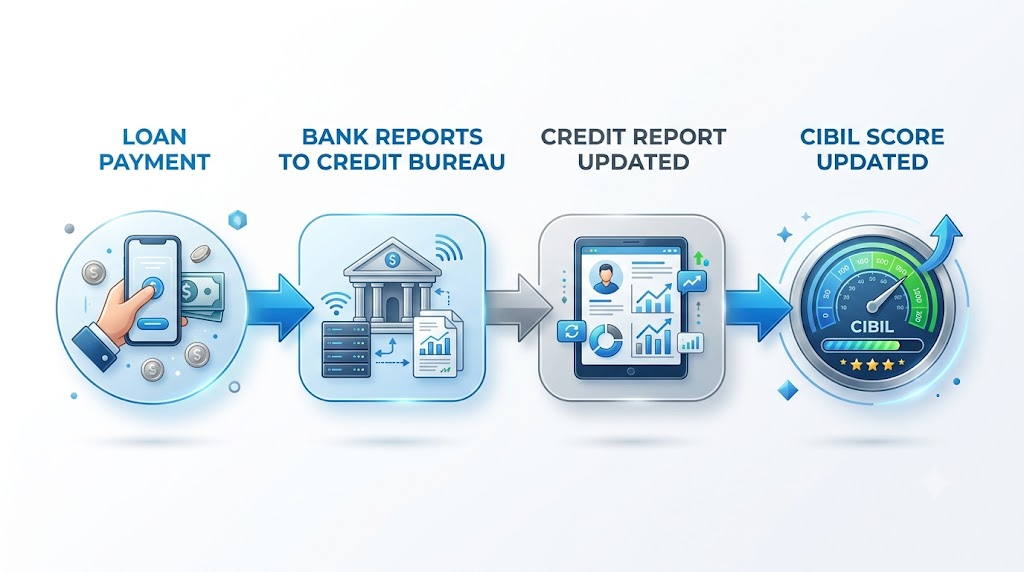
Two people who behave almost identically can still see different score changes in the same month, simply because their lenders report on different dates.
Tip: If your score drop feels disconnected from anything you’ve done, wait for the next reporting cycle before assuming there’s a deeper issue. It may simply be a timing gap between your bank and the bureau.
12 Common Reasons Your CIBIL Score Might Have Dropped
1. A Missed or Late EMI Payment
Missed and late payments are the most common and most impactful reason a score drops. Loan and credit card payments are reported based on how many days past the due date they were paid. Even a payment made 30 days late can be marked as a default for that billing cycle, and this stays on your report for a significant period. The impact tends to be larger if it’s a recent event, and it typically causes one of the steeper single-cause drops on this list.
2. High Credit Card Utilisation
Credit utilisation — how much of your available credit limit you’re using — carries meaningful weight in most bureau scoring models. Suppose your credit score is 720 and you normally keep your utilisation below 30%. If you used 80–90% of your limit in a particular month, even temporarily, your score can dip noticeably on your next report, regardless of whether you paid the full bill afterward.
Tip: Paying down your balance before your statement generation date, not just before the due date, is what actually helps utilisation-related dips recover faster.
3. A New Hard Inquiry
Every time you apply for a loan or credit card, the lender performs a “hard inquiry” to check your credit report, and this is recorded. A single inquiry usually causes a small, short-lived dip. Multiple inquiries within a short window — for example, applying to four lenders for a personal loan in the same month — can compound and signal higher risk to the scoring model, even if you’re eventually approved by one of them. Reviewing Personal Loan Eligibility in India for each lender beforehand can help you apply more selectively and avoid generating inquiries you didn’t need.
4. Closing an Old Credit Card or Loan Account
This one surprises a lot of people. Closing your oldest credit card can shorten your average credit history length and reduce your total available credit, both of which factor into your score. If that card also had a low utilisation ratio, closing it can push your overall utilisation percentage higher across your remaining accounts, indirectly lowering your score.
5. Loan Settlement Instead of Full Closure
Loan settlement versus full closure is one of the most confused areas among borrowers, so it’s worth being precise about it.
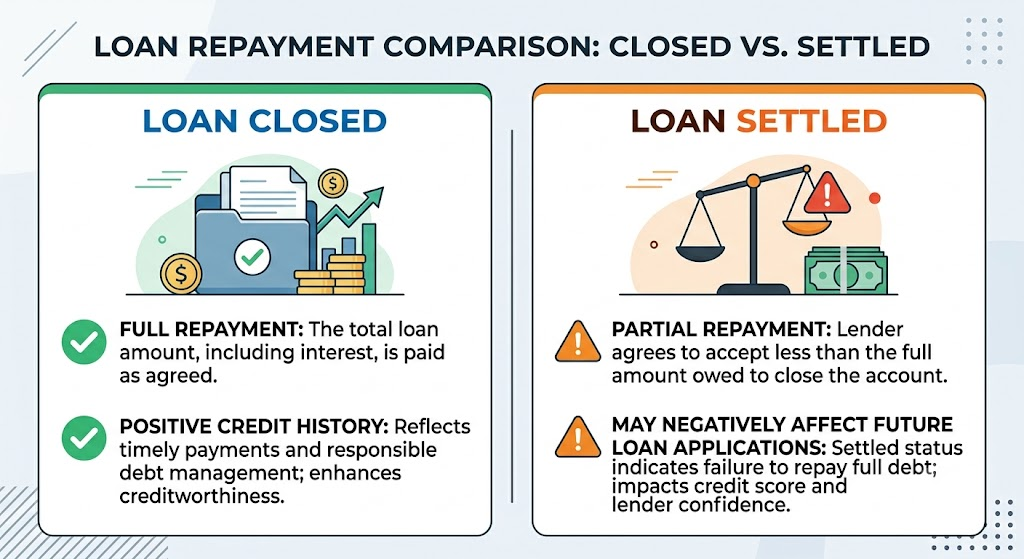
- Loan closure means you repaid the entire outstanding amount as originally agreed. Your report shows the account as “Closed.”
- Loan settlement means you and the lender agreed to close the account for less than the full amount owed, often after a period of default. Your report shows the account as “Settled,” which credit bureaus and future lenders generally treat as a sign of repayment risk.
A settlement can cause a significantly larger and longer-lasting score impact than a late payment, because it signals that the debt wasn’t repaid in full. If you have any settled accounts, this is often one of the first places to look when your score has dropped.
Remember: “Settled” and “Closed” look similar at a glance but mean very different things to a future lender. If you’re unsure which status applies to an old loan, it’s worth checking your report directly rather than assuming.
6. Becoming a Guarantor or Co-Applicant for a Defaulted Loan
If you’re a guarantor or co-applicant on someone else’s loan and they miss payments, that default can appear on your own credit report too — not just theirs. This is often overlooked because the reader themselves didn’t take any new loan or miss any payment, which makes the score drop feel confusing until they check who they’ve co-signed for. Our [Debt-to-Income Ratio Explained] article covers how co-signed obligations factor into a lender’s overall view of your finances.
7. An Increase in Your Overall Debt-to-Income Exposure
Taking on a new loan — even one you’re comfortably repaying — increases your total outstanding debt. Bureaus factor in how much of your income is likely committed to debt repayment. A new loan can cause a temporary dip even with perfect payment behaviour, simply because your overall exposure has increased.
8. Reporting Errors or Data Mismatches
Sometimes the drop isn’t about your behaviour at all — it’s a data issue. A lender might report a payment late due to an internal processing delay, misreport an account as active when it’s closed, or mismatch account details due to a name or ID discrepancy. If your score drop doesn’t match anything you can account for, this is worth investigating directly rather than assuming a hidden financial mistake.
9. A Recent EMI Bounce Due to Insufficient Balance
Even a single failed auto-debit — not a full missed payment, but a bounced EMI due to timing issues with your bank balance — can sometimes get reported depending on how your lender processes it. It’s a different situation from a deliberate missed payment, but it can still show up as a negative remark if not corrected quickly.
10. Multiple New Credit Accounts Opened in a Short Period
Opening several new lines of credit close together — a credit card, then a personal loan, then a BNPL account — can lower your average account age and increase the number of hard inquiries at once, both of which affect the score even if every payment afterward is made on time.
11. Switching or Restructuring an Existing Loan
Loan restructuring, part-prepayment adjustments, or moving to a different repayment scheme can sometimes cause temporary reporting inconsistencies, especially if the new terms take a cycle or two to reflect accurately.
12. Bureau-Specific Scoring Differences
CIBIL is one of several credit bureaus operating in India, alongside Experian, Equifax, and CRIF High Mark. Each bureau may receive slightly different reporting from lenders and use its own scoring model, so your CIBIL score and, say, your Experian score are not always identical. If you’re comparing scores across two different bureaus or two different points in time, some variation is expected and isn’t necessarily a red flag.
Which Reasons Usually Cause a Small Dip vs. a Big Drop
| Impact Level | Typical Causes | Recovery Pattern | What Helps |
|---|---|---|---|
| Small, usually temporary | Single hard inquiry, high utilisation in one cycle, opening one new account | Often corrects within 1–2 reporting cycles once behaviour normalises | Let the next statement cycle pass; avoid stacking more inquiries or high balances in the meantime |
| Moderate | Multiple inquiries close together, closing an old account, rising overall debt | Can take a few months of consistent good behaviour to recover | Space out new applications, keep older accounts open where possible, and pay down balances steadily |
| Significant, longer-lasting | Missed/late EMI, loan settlement, guarantor default, repeated late payments | Can take several months to over a year, depending on severity and subsequent repayment behaviour | Bring accounts current immediately, set up autopay, and build a longer streak of on-time payments going forward |
These timeframes vary by individual profile and lender reporting practices, so treat this as a general pattern rather than a fixed timeline.
How to Find the Exact Reason Behind Your CIBIL Score Drop
Guessing rarely helps here — the fastest way to understand a drop is to go through your report methodically rather than jumping straight to conclusions. A short, structured review usually points to the cause within a few minutes.
- Check your latest credit report in full, not just the headline score. The score is a single number; the report is where the actual reasons live.
- Compare it against your previous report, if you have one saved. Look specifically at what changed — a new account, a status update, a new inquiry — rather than re-reading the whole document line by line.
- Review your payment history section for any account marked late, missed, or overdue, including smaller accounts you might not think of first, like a store card or a co-signed loan.
- Check the hard inquiries section to see if any new applications were logged recently, and by whom.
- Look for reporting errors — accounts you don’t recognise, incorrect balances, or a status that doesn’t match your own records.
- Note any change in your credit utilisation across each card individually, since a single high-usage card can outweigh several low-usage ones.
Working through these six checks in order usually narrows the cause down to one or two likely candidates, which makes the next step — deciding what to do about it — much more straightforward.
What to Do If Your CIBIL Score Drops Suddenly
Once you’ve identified the likely cause using the checks above, here’s how to prioritise your next steps:
- Confirm the cause first, rather than acting on assumption — the response to a utilisation spike is very different from the response to a settled loan.
- If it’s a missed payment, bring the account current immediately if you haven’t already, and set up autopay or reminders going forward.
- If it’s high utilisation, focus on paying down balances before your statement date rather than only before the due date.
- If you spot a “Settled” status you weren’t expecting, contact the lender directly to understand the account history and whether it was reported correctly.
- If something looks outright incorrect — an account you don’t recognise or a mismatched detail — raise a formal dispute directly with the credit bureau and the lender, since corrections need to be updated on their end, not just noticed by you.
- If nothing seems wrong at all, it may simply be a timing gap between your bank’s reporting cycle and your score update — in which case, monitoring your next report is usually enough.
Common Myths About CIBIL Score Drops
“Checking my own score lowers it.” Checking your own report is a soft inquiry and does not affect your score. Only lender-initiated hard inquiries can have an impact.
“Paying off a loan early always boosts my score immediately.” It often helps over time, but if it closes your oldest account or reduces your credit mix, the short-term effect can be neutral or even slightly negative before it improves.
“A settled loan is the same as a closed one, as long as it’s paid.” As explained above, these are treated very differently by lenders reviewing your report in the future.
Realistic Expectations for Recovery
There’s no fixed number of points a score will regain in a set time, and any source promising that isn’t giving you accurate guidance — recovery depends on the underlying cause, your overall credit behaviour, and how each lender chooses to report going forward. What generally helps is consistent, on-time repayment, keeping utilisation low relative to your limits, avoiding unnecessary new credit applications, and correcting any genuine reporting errors as soon as you spot them.
Here’s a general sense of how recovery tends to unfold, depending on what caused the drop:
- High utilisation in one cycle: Usually the fastest to recover — often reflects positively as soon as your next lower-balance statement is reported.
- A single hard inquiry: Its influence tends to fade naturally over the following months as it becomes less recent.
- A reporting error: Recovery depends on how quickly the lender corrects the data with the bureau once you’ve raised it — this is more about follow-up speed than time passing on its own.
- A late or missed EMI: Takes longer, and generally improves as you build a longer streak of on-time payments afterward.
- A loan settlement: The slowest to recover from, since it reflects on your report for an extended period regardless of later repayment behaviour.
For most people, a score that dropped due to a single identifiable event tends to recover gradually as newer, positive repayment history replaces the older negative mark in the bureau’s calculation. A sudden drop can feel alarming in the moment, but it’s rarely permanent and is almost always explainable once you look closely. The most productive response isn’t to panic over the number itself — it’s to identify the actual cause, correct anything that’s genuinely wrong, and let consistent financial habits do the rest over time.
Financial Disclaimer
Credit scoring criteria, reporting timelines, and recovery patterns can vary between lenders and credit bureaus. This article is intended for general understanding only. For details specific to your credit report or a particular account, verify directly with CIBIL, your lender, or a qualified financial advisor.