
Missing one EMI on an education loan feels different from missing a credit card payment. There’s usually a co-borrower involved — a parent, often — and the loan was taken for something that was supposed to open doors, not close them. So when repayment gets difficult, the anxiety isn’t just financial. It’s personal.
Here’s the short answer: non-repayment doesn’t lead to arrest or immediate asset seizure. It leads to a sequence of escalating consequences — credit score damage, penalty charges, recovery notices, and eventually legal action — that unfolds over months, not days. How severe it gets depends heavily on whether the loan is secured or unsecured, and on how early you respond.
Quick Summary
- After a missed EMI: The lender flags the account as delinquent and usually starts with reminder calls, SMS, and emails — nothing legal happens immediately.
- After 90 days: Under RBI norms, the account is classified as a Non-Performing Asset (NPA), which shifts the lender from reminders to formal recovery.
- Credit score: Even one reported missed EMI can pull your score down; the exact drop depends on your existing credit profile, and it tends to worsen with each further miss.
- Secured vs. unsecured: Secured loans (with pledged collateral) can potentially lead to SARFAESI-based recovery; unsecured loans go through slower civil court or Debt Recovery Tribunal routes.
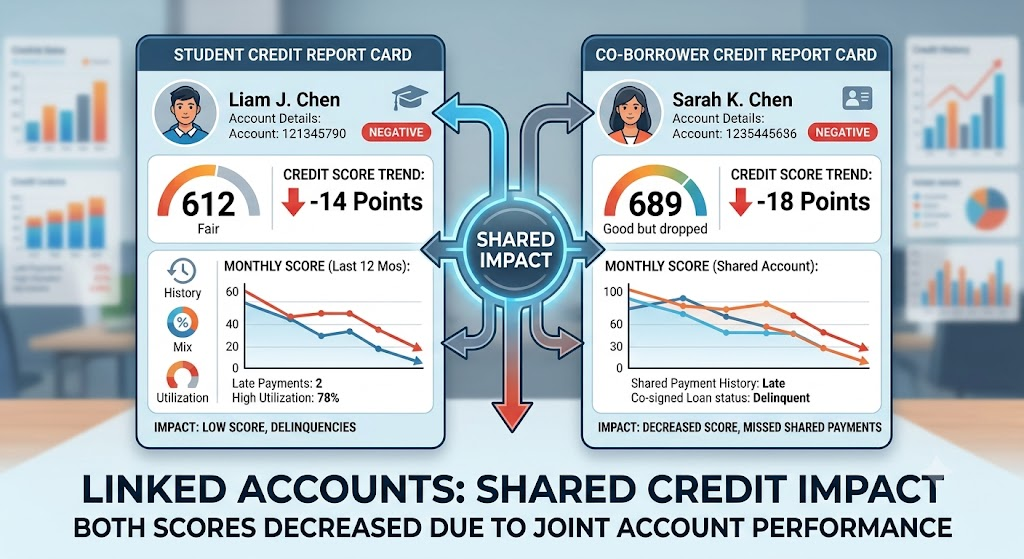
- Co-borrower liability: A parent or guarantor is equally liable, not just the student — their credit report and legal exposure are affected the same way.
The First 90 Days: What Actually Happens
Nothing dramatic happens the day after a missed EMI. Lenders classify a loan as “delinquent” as soon as a payment is missed, but this is an internal flag, not a default in the legal sense. Most banks and NBFCs will start with phone calls, SMS reminders, and emails during this window.
What does change immediately is your credit report. Lenders typically report repayment status to credit bureaus such as TransUnion CIBIL, Experian, Equifax, and CRIF High Mark — usually every month. The exact impact depends on your existing credit profile, but even a single reported missed EMI can negatively affect your credit score, and the effect tends to compound with each subsequent miss.
If the EMI remains unpaid for 90 consecutive days, the account crosses a threshold that matters a lot: under the Reserve Bank of India’s asset classification norms, the lender is required to classify it as a Non-Performing Asset, or NPA. This is the point where “late payment” turns into what most people mean when they say “default.”
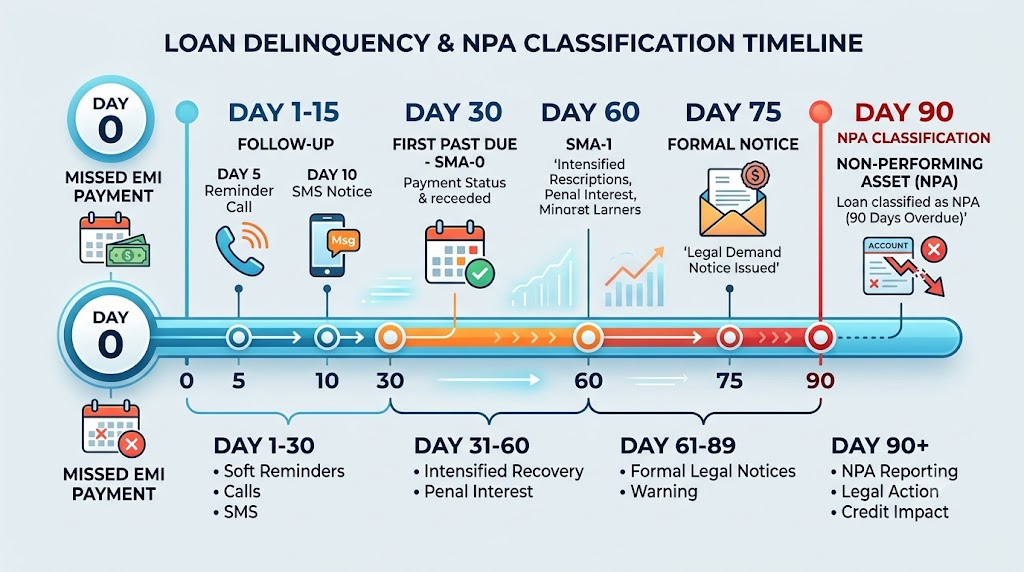
Why the 90-Day Mark Changes Everything
Once an account becomes an NPA, the lender’s internal handling shifts from a collections process to a recovery process. A few things tend to follow:
The credit score damage becomes sharper. Instead of small dips per missed EMI, an NPA classification is commonly associated with a steeper fall — the exact impact depends on your existing credit profile, but this stage typically does more damage to your score than the missed EMIs that preceded it, and bureaus like CIBIL will reflect the NPA status clearly on your report.
The lender’s internal team, or a third-party recovery agency it works with, gets more actively involved. Under the RBI’s fair practices code for lenders, recovery agents are required to identify themselves, avoid contacting borrowers at unreasonable hours, and refrain from any form of intimidation. In practice, enforcement of these norms varies, and borrowers who feel a recovery agent has crossed a line can file a complaint with the lender’s grievance cell or escalate it under the RBI Integrated Ombudsman Scheme.
Formal written notices start arriving. Before any recovery action, you’re legally entitled to a notice specifying the outstanding amount and a reasonable window to respond.
Secured vs. Unsecured Education Loans: Why It Matters So Much
This is the distinction that decides how serious things can get, and it’s one that a lot of general finance content glosses over.
Many education loans — particularly for study abroad or amounts above roughly ₹7.5 lakh — are secured against collateral: usually a parent’s property or a fixed deposit. Loans below that threshold are, per Indian Banks’ Association guidance, generally not expected to require collateral, though individual lender policy can vary and it’s worth confirming this directly with your bank rather than assuming it applies to your specific loan.
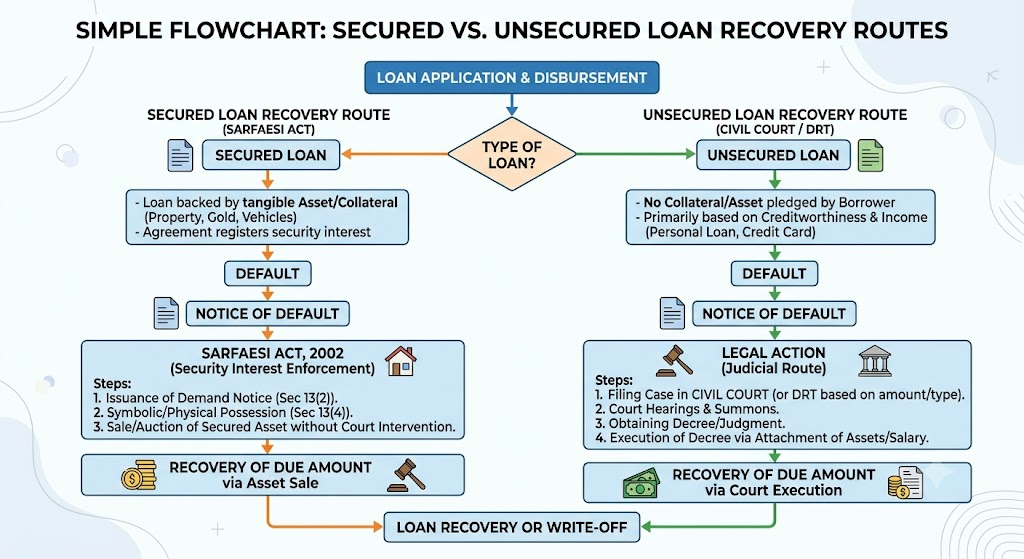
If your loan is secured and it becomes an NPA, the lender can potentially invoke the SARFAESI Act. This law allows certain financial institutions to take possession of pledged property and sell it to recover dues, generally without going through a civil court first, provided they follow the required demand notice and possession notice periods and procedural steps laid down under the Act. This is the scenario people are usually afraid of when they ask what happens if a loan isn’t repaid, and it’s real, but it applies specifically to secured loans where collateral was pledged — and the exact timeline can vary by case, so it’s worth reviewing the notice you receive carefully or with a lawyer rather than assuming a fixed schedule.
If your loan is unsecured, there’s no asset for the lender to seize directly. Recovery instead goes through slower legal channels — a civil suit, or for larger amounts (loans above ₹20 lakh, broadly), the Debt Recovery Tribunal. These processes take time, and they come with legal costs that, if the lender wins the case, are often added to what the borrower owes. If you’re unsure which category your loan falls into, it’s worth working through a debt-to-income ratio check alongside your loan documents before assuming the worst.
| Loan Type | Typical Recovery Route | Speed |
|---|---|---|
| Secured (collateral pledged) | SARFAESI Act — possession/sale of pledged asset | Faster, can proceed without court order after notice |
| Unsecured, loan amount ≤ ₹20 lakh | Civil court proceedings | Slower |
| Unsecured, loan amount > ₹20 lakh | Debt Recovery Tribunal (DRT) | Slower, but structured for larger disputes |
Because this varies by lender and loan structure, it’s worth checking your original loan agreement or asking your bank directly whether your loan is secured, and if so, what specific asset is pledged. If you’re not sure what your paperwork actually says, it can help to revisit what documents your education loan file should contain so you know exactly what to look for.
What Happens to Your Guarantor or Co-Borrower
Most education loans in India have a co-borrower — usually a parent — and this is where the consequences of default extend well beyond the student.
The co-borrower is equally liable for the debt, not secondarily liable. That means their credit report takes the same hit as the student’s. If the lender pursues recovery, it can pursue the co-borrower with the same legal standing it uses against the primary borrower, including approaching them first if that seems more likely to result in repayment.
Consider two situations side by side. In one, a fresh graduate with an irregular freelance income defaults and has no assets of their own — the practical burden of any recovery action, and any credit score repair work, may fall largely on the co-signing parent. In the other, a salaried graduate with a stable job defaults temporarily due to a medical emergency — restructuring the loan may be a realistic option precisely because a steady income exists, which is not the case in the first scenario. The lender’s willingness to negotiate often depends on which of these situations more closely resembles yours.
There’s a third, fairly common scenario worth walking through: a graduate whose job offer falls through, or who is laid off a few months into their first role, before the EMI schedule has even properly begun. The instinct in this situation is often to go quiet — to avoid the bank’s calls until there’s actually money to send. In practice, this tends to backfire. Lenders are generally far more willing to extend the moratorium period, temporarily lower the EMI, or restructure the schedule when a borrower reaches out before missing a payment, rather than after. A short email or branch visit explaining the situation, along with whatever documentation is available (a termination letter, for instance), often opens options that simply aren’t on the table once the account has already slipped past a few missed EMIs. It’s a small window, but it’s a real one — and it’s usually the cheapest way to avoid the rest of this article applying to you at all.
Does Non-Repayment Ever Lead to Jail?
Generally, no. Failing to repay an education loan is a civil matter in India, not a criminal one. You are not imprisoned simply for being unable to pay.
There’s an important exception: if repayment was attempted through post-dated cheques and those cheques bounced, that specific act can attract criminal liability under Section 138 of the Negotiable Instruments Act. Similarly, if a borrower is found to have misrepresented facts on the loan application or diverted loan funds fraudulently, that opens a different, more serious legal track. Genuine inability to pay, without fraud, does not carry criminal exposure — but this is a meaningful legal distinction, and if you’re facing a cheque-bounce notice specifically, that’s worth discussing with a lawyer rather than assuming it will resolve like an ordinary default.
The “Willful Defaulter” Tag — A Separate, More Serious Category
RBI guidelines allow lenders to classify certain defaulters as “willful defaulters” — a designation reserved for cases where the borrower had the capacity to repay but chose not to, or diverted funds for purposes other than what the loan was meant for. This tag is far more damaging than an ordinary NPA classification: it can block you from accessing credit from any regulated lender for a period, and it follows you in a way a routine default doesn’t.
This is not the default category most people worry about. A borrower who’s genuinely struggling — reduced income, job loss, family emergency — is generally treated differently from one who has the means to pay and simply refuses to. Lenders and RBI norms do draw this distinction, even if the initial notices you receive can feel identical either way.
How Long Does the Damage Actually Last?
This is where a lot of borrowers assume the worst permanently. It’s worth separating two different things: the credit report entry, and the ability to actually rebuild a workable score.
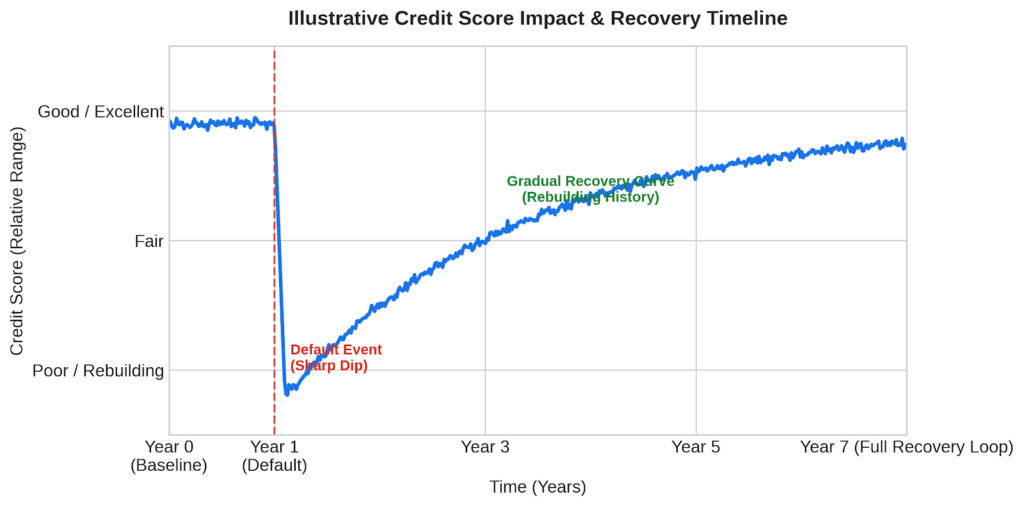
A default or settled-account remark typically remains visible on your credit report for around seven years from the date of the first missed payment, based on how CIBIL and other RBI-recognised bureaus structure their reporting windows. But “visible” doesn’t mean your score is frozen at its lowest point that whole time. If you resume consistent, on-time payments — either on a restructured version of the same loan or on new, smaller credit obligations — your score generally starts recovering within a couple of years, even while the old entry sits in your history. It’s worth understanding what factors actually move your CIBIL score if you’re trying to rebuild it deliberately rather than just waiting it out. Lenders reviewing a fresh application tend to weight recent behavior more heavily than an old, resolved default, though this isn’t guaranteed and varies by institution.
One thing worth flagging honestly: if a lender eventually writes off part of your loan as unrecoverable, tax authorities may in some cases treat the written-off amount as income in your hands, which can result in an unexpected tax query. This is a lesser-known consequence, and if you’re negotiating a settlement, it’s worth asking your CA or the lender directly how the write-off will be reported.
What You Can Do Before It Reaches This Stage
None of this is meant to suggest that default is unmanageable once it starts, or that reaching out to your lender is a lost cause.
Restructuring: Lenders can, at their discretion, extend the loan tenure, reduce the EMI temporarily, or offer a fresh moratorium if you contact them before the account becomes an NPA. This is far easier to negotiate proactively than reactively — if you’re weighing whether restructuring makes sense for your situation, walking through how EMI restructuring actually works first helps you go into that conversation with realistic expectations rather than requesting a change blind.
One-Time Settlement (OTS): Once an account has been an NPA for a while, some lenders are open to accepting a lump sum that’s less than the full outstanding amount, closing the account as “settled.” This does still show up on your credit report as settled rather than closed in full — which is a meaningfully worse mark than a clean closure — so it should generally be a last resort rather than a first move, and ideally reviewed with a chartered accountant before you accept. On the flip side, if your finances do recover and you’re deciding whether to close the loan faster than scheduled, it’s worth separately understanding when prepaying a loan is actually worth it, since that calculation is quite different from a settlement decision.
Interest subsidy schemes: If your loan falls under a scheme such as the Central Sector Interest Subsidy Scheme (for economically weaker sections during the moratorium period), it’s worth checking your eligibility before assuming default is the only option — this can meaningfully reduce what you owe if you qualify.
Grievance redressal: If you feel a recovery agent has behaved unfairly, or a lender hasn’t followed RBI’s fair practices code, you can raise it with the lender’s internal grievance officer first, and escalate under the RBI Integrated Ombudsman Scheme if it remains unresolved.
A Quick Reality Check on Timing
Waiting is sometimes the wrong instinct, and sometimes the right one, depending on the situation. If your income is temporarily disrupted but recovering — say a job offer is a few months out — proactively requesting a short restructuring is usually stronger than defaulting first and negotiating later, since lenders tend to be more flexible before NPA classification than after. On the other hand, if your financial situation is genuinely unstable with no clear recovery timeline, exploring settlement options earlier, before penalty interest compounds further, is often more realistic than committing to a repayment plan you’re likely to miss again.
Common Mistakes to Avoid
A lot of the damage in these situations comes not from the default itself, but from how it’s handled in the weeks around it. A few patterns show up repeatedly:
Ignoring the bank’s calls. It’s tempting to let calls from an unknown number go unanswered when you know it’s about an overdue EMI, but silence is generally read as unwillingness to engage, not just inability to pay — and it removes your chance to negotiate before things escalate.
Not informing the lender about genuine hardship. Job loss, medical emergencies, and pay cuts are common, and lenders generally do have some flexibility for these situations — but only if they know about it. Assuming the bank “won’t care” and staying quiet usually closes doors that a short conversation would have kept open.
Taking a loan app loan to cover another EMI. Using a quick, high-interest app-based loan to plug a gap in your education loan repayment tends to create a second, faster-moving problem rather than solving the first one. It’s worth being especially cautious here, since some of these apps operate outside RBI-regulated channels entirely.
Waiting until the account becomes an NPA to act. Almost everything discussed above — restructuring, moratorium extensions, negotiated EMI reductions — is easier to arrange before the 90-day NPA mark than after. Waiting to “see if things improve” is understandable, but it often means losing access to the more flexible options.
Trusting unsolicited settlement agents. If someone claiming to “settle” your loan for a fee contacts you directly, especially outside your bank’s official channels, treat it with real suspicion. Genuine settlement discussions happen through the lender or an RBI-recognised grievance process, not through a stranger who found your number.
In Short
Not repaying an education loan sets off a defined sequence: missed EMI, credit score damage, NPA classification at 90 days, formal notices, and — depending on whether the loan is secured — either SARFAESI-based asset recovery or civil/DRT proceedings. Co-borrowers share the full impact. Jail is not a realistic outcome for genuine default, though cheque bounce and fraud are separate, more serious tracks. And while the credit damage is real and visible for years, it isn’t permanent or unrecoverable if you act early and communicate with your lender rather than avoiding the issue.
This article is intended for general educational purposes and explains typical patterns under RBI guidelines and industry practice. Actual policies, timelines, and recovery procedures can differ between banks and NBFCs, and individual loan agreements may include terms not covered here. It is not a substitute for advice from your lender or a qualified financial or legal professional — please verify current details directly with your loan provider before making any decision.
Official References
- Reserve Bank of India (RBI)
- TransUnion CIBIL
- Indian Banks’ Association (IBA)
- Central Sector Interest Subsidy Scheme (CSIS)
FAQs
Does one missed EMI count as a default?
No. A single missed payment is typically flagged as delinquent, not defaulted. Default in the practical, NPA sense generally applies after 90 consecutive days of non-payment.
Can the bank take my parents’ house if I default?
Only if the house was specifically pledged as collateral for that loan and the loan is classified as an NPA, following the SARFAESI notice procedure. If no property was pledged, this specific risk doesn’t apply.
Will my credit score recover after a default?
It can improve over time with consistent on-time payments on other credit, even though the default entry itself may stay on your report for around seven years.
Is defaulting on an education loan a criminal offense?
Generally no — it’s a civil matter. Criminal liability applies only in specific situations like cheque bounce under Section 138 of the Negotiable Instruments Act, or proven fraud.