
If you’ve missed an EMI recently, you’re probably not looking for a lecture on financial discipline. You want a straight answer to one question: can a missed EMI affect future loan approval, and will this come back to bite you the next time you apply for a loan?
The short version — yes, it can, but how much it affects you depends on things like how late the payment was, how often it happens, and how the rest of your credit profile looks. A single EMI paid a few days late is a very different story from three months of missed payments on a personal loan. Lenders don’t read your credit report as a yes/no filter. They read it as a pattern.
The rest of this article walks through what actually happens behind the scenes — what gets reported, what lenders see, and what you can realistically do about it.
Quick Answer: Can Missed EMI Affect Future Loan Approval?
- Yes, a missed EMI can affect future loan approval, but the impact depends on how late the payment was and whether it was a one-off or a pattern.
- A single EMI paid a few days late generally carries far less weight than an account that goes 30+ days past due (DPD).
- Lenders look at recent behavior more closely than older missed payments, especially if your repayment history has been clean since.
- Being affected doesn’t always mean rejection — it can also mean a lower sanctioned amount, a higher interest rate, or extra documentation requests.
- Paying off the missed EMI and staying consistent afterward matters more to future approval than the missed payment itself.
- There’s no legitimate way to erase an accurate missed-payment record from your credit report — only time and consistent repayment change how it’s viewed.
What Happens the Moment You Miss an EMI
Most loan agreements build in a short grace period before a missed payment is formally reported as an overdue instalment. The exact cutoff varies by lender — some report after a few days, others wait until the payment is a certain number of days past due. Because this differs across banks and NBFCs (non-banking financial companies, which are lenders that aren’t traditional banks), it’s worth checking your loan agreement or asking your lender directly rather than assuming a fixed number of days applies everywhere. Lenders in India operate within the broader regulatory framework set by the Reserve Bank of India (RBI), though day-to-day reporting timelines and internal grace periods are generally set by individual institutions rather than being uniform across the industry.
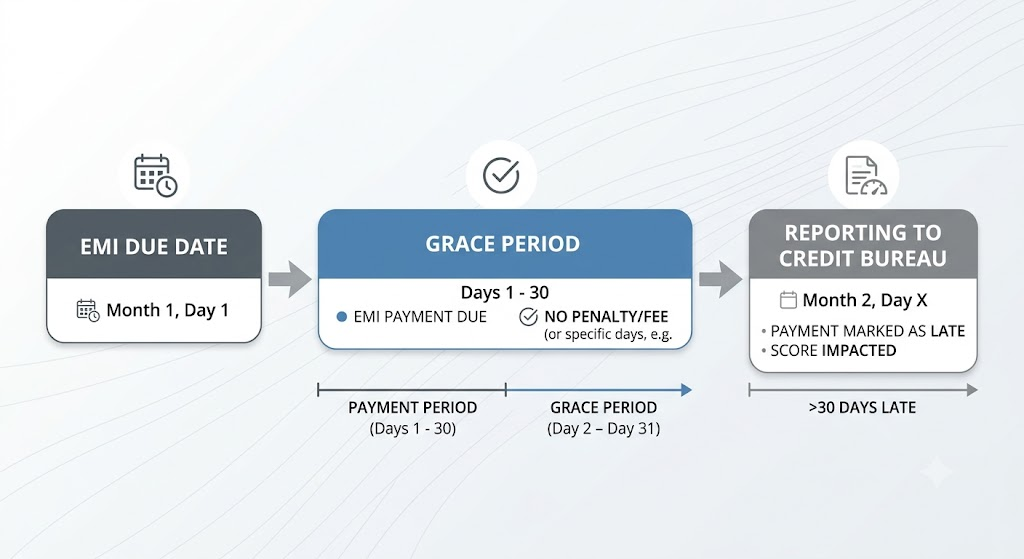
Once a missed payment is reported, it typically shows up in your credit report in a section that records your payment history for each active loan or credit account, month by month. This is usually visible as “days past due” (DPD) figures — for instance, DPD of 30 means the payment was reported as thirty days late that month. This detail matters more than most people realize, because a lender reviewing your application later isn’t just checking whether you’ve ever missed a payment. They’re looking at how late it was, and whether it repeated.
Does One Missed EMI Really Hurt Your Credit Score?
This is where a lot of the anxiety comes from, and the honest answer is: it depends, but a single isolated late payment — especially one that was corrected quickly — usually has a smaller and more temporary effect than people assume.
Credit scoring models used by bureaus such as TransUnion CIBIL, Experian, Equifax, and CRIF High Mark weigh payment history heavily, but they also account for the rest of your credit behavior — your credit utilization, the age and mix of your credit accounts, and how many recent credit inquiries you’ve had. If you want a broader understanding of how these factors combine, our Credit Score Guide breaks each one down individually. A borrower with several years of clean repayment history who misses one EMI due to a bank holiday mix-up or a delayed salary credit is in a different position than someone whose repayment history shows repeated delays across multiple accounts.
What tends to matter more to future loan approval isn’t the single missed payment itself, but:
- Whether it was an isolated incident or part of a recurring pattern
- How quickly it was paid after being missed
- Whether the loan account was eventually closed in good standing or written off
- How the rest of your credit report looks around that period
Suppose your credit score sits at 750 and you miss one EMI by four days because of a technical issue with auto-debit, then pay it immediately once you notice. That’s a meaningfully different situation from a self-employed borrower whose irregular income has led to three missed payments across two loans in the past year. Both are “missed EMI” situations, but lenders are unlikely to weigh them the same way.
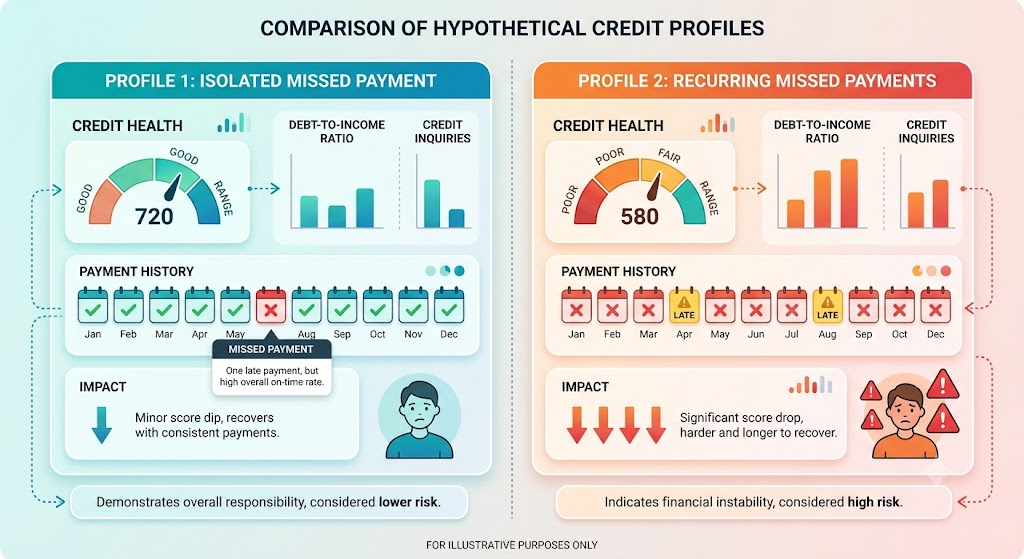
To make this easier to visualize, here’s a general comparison of how different repayment scenarios tend to be viewed. These are broad tendencies, not fixed rules — actual outcomes depend on the specific lender and the rest of the applicant’s profile.
| Scenario | Typical Effect on Credit Score | Typical Effect on Future Loan Approval |
|---|---|---|
| EMI paid a few days late (within grace period) | Minimal to none, if not reported as overdue | Usually negligible on its own |
| One isolated missed EMI, paid soon after | Small, often temporary, dip | Usually treated as a minor flag, not a dealbreaker |
| 30+ Days Past Due (DPD) | More noticeable and longer-lasting impact | May lead to closer scrutiny, added documentation, or a lower sanctioned amount |
| Multiple missed EMIs across accounts | Larger cumulative impact | Higher chance of rejection or significantly adjusted terms |
| Loan settled (paid less than full outstanding amount) | Negative marker distinct from normal closure | Often viewed cautiously, as “settled” differs from “closed” on a report |
| Loan written off | Significant, long-lasting negative impact | Commonly a major red flag for most lenders |
If you’re unsure which category your situation falls into, reviewing your actual account status with your lender or checking your report directly is more reliable than estimating from general guidance like this.
What Lenders Actually Look At When You Apply Again
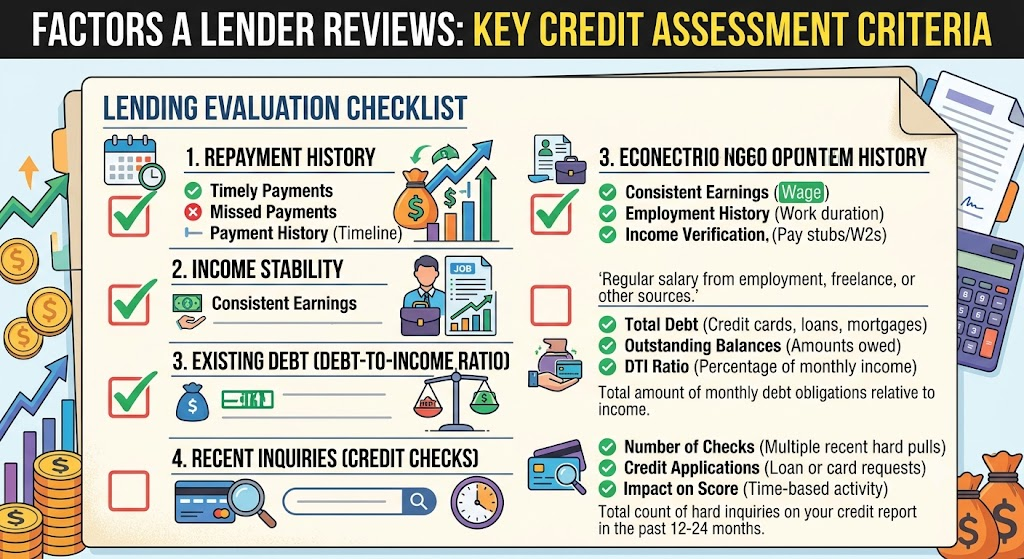
When you apply for a new loan — whether it’s a personal loan, a home loan, or a credit card — the lender pulls your credit report and looks at more than just your score. They typically also examine your account-level repayment history for each loan you’ve held, your current outstanding debt relative to your income (often referred to as your debt-to-income ratio), your employment stability, and how recently the missed payment occurred.
A missed EMI from three years ago, followed by a clean repayment record since, is treated very differently from a missed EMI in the last two or three months. Most lenders give more weight to recent behavior, though exact policies vary and aren’t publicly standardized across all banks and NBFCs.
It’s also worth understanding that “affecting approval” doesn’t always mean outright rejection. In practice, a missed EMI in your history can also lead to:
- A lower loan amount being sanctioned than requested
- A higher interest rate being offered, since the lender may price in additional risk
- A request for additional documentation or a co-applicant/guarantor
- A longer processing time while the lender manually reviews the file
Because these outcomes vary by lender and by the specifics of the applicant’s file, it’s not accurate to say a missed EMI always leads to rejection — but it’s equally inaccurate to assume it has no effect at all. If you’d like to see how this fits alongside other factors, our guide to common loan rejection reasons covers the full picture beyond just repayment history.
Salaried vs Self-Employed: Does It Matter Here?
It can, though not in the way people often assume. Salaried applicants usually have a more predictable income pattern reflected in their bank statements and salary slips, which can make it easier for a lender to distinguish a one-off missed EMI from a genuine repayment risk. Self-employed applicants, whose income may be irregular month to month, sometimes face closer scrutiny of missed payments simply because lenders have less standardized income documentation to lean on for context.
This doesn’t mean self-employed borrowers are treated unfairly — it means the burden of explaining a missed payment, through updated income proof or a written clarification, may fall more on them during the application process. Keeping your paperwork current also helps here — our Personal Loan Documents Checklist covers what most lenders ask for when reviewing an application more closely.
If You Already Have a Missed EMI, What Can You Actually Do?
There’s no way to erase a reported missed payment from your credit history retroactively, and be cautious of anyone who claims they can guarantee its removal — credit bureau records are meant to reflect actual repayment behavior. What you can influence is what happens next.
Pay it off completely and keep the account current going forward. A single missed EMI followed by consistent on-time payments for the following months tends to matter more to future lenders than the missed payment in isolation. Time and consistent behavior are doing a lot of the work here, not any quick fix.
Get a written closure or settlement letter if the account was affected. If a missed payment escalated to a loan being restructured, settled, or written off, make sure you have documentation showing the current status. Lenders reviewing your file later may ask for this directly.
Check your credit report for accuracy. Sometimes a payment that was actually made on time gets misreported due to a processing delay or a bank error. If you believe a missed EMI entry on your report is incorrect, you can raise a dispute directly with the credit bureau — this is a legitimate process, not a workaround, and it only helps if the entry is genuinely inaccurate. Our guide on identifying and disputing credit report errors walks through that process step by step.
Avoid applying for new credit immediately after a missed payment. Each new loan or credit card application can trigger what’s called a hard inquiry on your credit report, and applying for several in a short window — right after a missed EMI — can compound the impact rather than offset it. In some cases, it may be worth waiting a few months and letting a stretch of on-time payments build back into your report before applying again, rather than applying immediately in the hope of getting ahead of it.
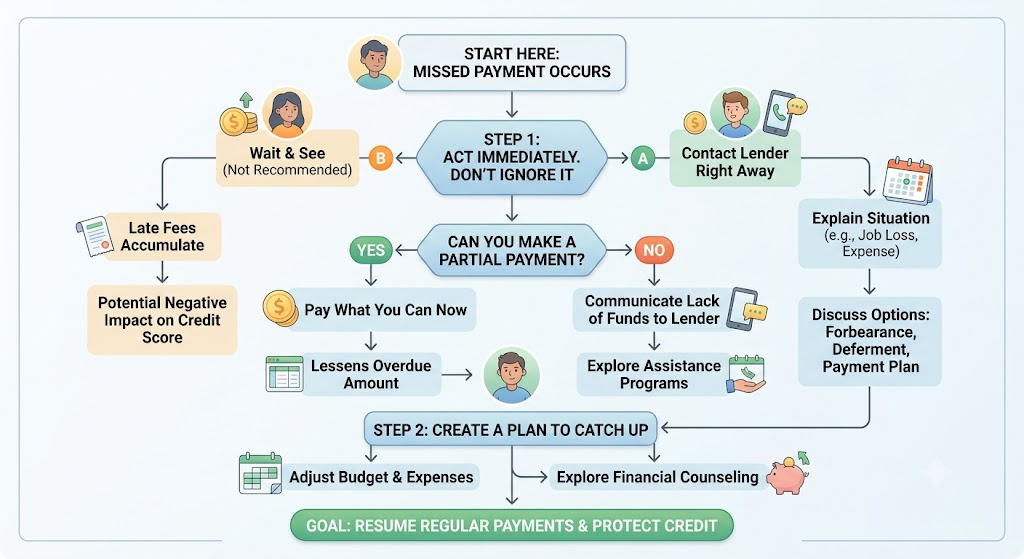
Talk to your existing lender before things escalate. If you know you’re going to miss a payment, or you’ve already missed one due to a temporary cash flow issue, contacting the lender proactively is often more useful than waiting for them to reach out. Some lenders offer restructuring or short-term relief options, though this varies by institution and by the type of loan.
A Few Common Misconceptions Worth Clearing Up
“One missed EMI ruins my credit score permanently.” Not accurate. Credit scores are dynamic and generally recalculated based on your most recent reported behavior, not locked in place by a single event.
“If I pay it off, the record disappears from my report.” Also not accurate. Paying off a missed EMI updates its status to reflect that it’s been settled, but the historical record of the late payment typically remains visible on your credit report for a period of time, even after resolution.
“Missed EMIs on any type of loan carry the same weight.” This isn’t necessarily true either. How much weight a lender gives a missed payment can depend on the type of loan involved, the amount, and how the specific lender’s internal policy treats different credit products — this is one of the areas where practices genuinely differ from one institution to another.
The Bigger Picture
A missed EMI is a signal, not a verdict. Lenders assessing a new application are trying to answer one practical question: is this a borrower likely to repay consistently going forward? A single, quickly corrected missed payment sitting inside an otherwise solid credit history usually answers that question differently than a pattern of repeated delays.
If you’re currently rebuilding after a missed payment, the most reliable path tends to be the least exciting one — pay consistently, keep your existing accounts in good standing, and give your credit report time to reflect that behavior before applying for new credit. There’s no shortcut that replaces this, regardless of what you may read elsewhere.
So, can a missed EMI affect future loan approval? Yes, in most cases it can — but rarely in a permanent or all-or-nothing way. The real determining factor is what your repayment behavior looks like in the months that follow.
Frequently Asked Questions
Can one missed EMI affect future loan approval?
Yes, it can, though it usually depends on how late the payment was and whether it was an isolated incident. A single EMI that was a few days late and corrected quickly tends to carry far less weight than a payment that stayed unpaid for 30 or more days. Lenders generally look at the full pattern of your repayment history rather than treating one entry as an automatic disqualifier.
How much does one missed EMI reduce a credit score?
There’s no fixed, universal number, since scoring models used by different bureaus weigh factors differently and don’t publish exact point deductions for specific events. What’s generally understood is that an isolated, quickly resolved missed payment tends to have a smaller and more temporary effect than a payment that goes significantly past due or repeats across multiple months.
How long does a missed EMI remain on a credit report?
A missed payment typically remains visible on your credit report for a period of time even after it’s been resolved, since credit reports are meant to reflect your actual repayment history rather than only your current status. The exact retention period can vary by bureau, so checking your report directly is the most reliable way to know what’s currently showing.
Can I get a home loan after missing an EMI?
It’s possible, especially if the missed EMI was an isolated event a while ago and your repayment history has been clean since. Lenders reviewing a home loan application, which is usually a larger and longer-term commitment, may look more closely at your overall credit behavior, current debt-to-income ratio, and income stability rather than rejecting an application solely because of one past missed payment.
Can I remove a missed EMI from my credit report?
Not if the entry is accurate — credit bureau records are meant to reflect real repayment behavior, and there’s no legitimate way to have a genuine missed payment erased early. If the entry is inaccurate, however, you can raise a dispute directly with the credit bureau to have it corrected.
Is one missed EMI worse than multiple late payments?
Generally, no. A single missed EMI that’s corrected quickly is usually viewed as far less serious than a pattern of multiple late or missed payments across accounts. Lenders tend to be more concerned with recurring behavior than with a one-off lapse.
Will banks reject my loan because of one missed EMI?
Not automatically. Many lenders weigh a single missed payment alongside your overall credit profile, income, and existing debt. Outright rejection is more commonly associated with repeated missed payments, high existing debt, or a recent pattern of financial strain, rather than one corrected instance.
What should I do immediately after missing an EMI?
Pay the outstanding amount as soon as possible, confirm with your lender that the payment has been received and processed, and check your credit report in the following billing cycle to make sure it’s been reported accurately. If the missed payment happened due to a temporary cash flow issue, it’s also worth speaking to your lender directly before it escalates further.
Key Takeaways
- A missed EMI can affect future loan approval, but the extent depends on how late it was, whether it repeated, and how the rest of your credit profile looks.
- Lenders generally weigh recent repayment behavior more heavily than older, resolved missed payments.
- The effect isn’t always outright rejection — it can also show up as a lower sanctioned amount, a higher interest rate, or added documentation requirements.
- Paying off a missed EMI and maintaining consistent, on-time payments afterward matters more to future approval than the missed payment itself.
- Settled and written-off accounts are generally viewed more seriously than a single missed-then-paid EMI, since they reflect a different repayment outcome.
- You cannot legitimately have an accurate missed-payment entry removed early, but you can dispute genuinely incorrect entries with the credit bureau.
- When in doubt, check your actual credit report and speak with your lender rather than relying on general assumptions about how missed payments are treated.
Financial Disclaimer
Loan eligibility, interest rates, credit scoring criteria, and lending policies vary between banks, NBFCs, and credit bureaus, and can change over time. This article is intended for general understanding only and should not be treated as financial or credit advice specific to your situation. Please verify current terms and policies directly with your lender or credit bureau before making financial decisions.